

Morocco and Switzerland have arrived at a similar crossroads, albeit from different vantage points. One nation boasts a long-standing tradition of cultivation, while the other is equipped with laboratories, teams of experts, and a federal mandate for research. Their shared challenge revolves around a pressing contemporary issue: having recognized the failure of prohibition to eradicate cannabis, what does effective regulation of its recreational use entail?
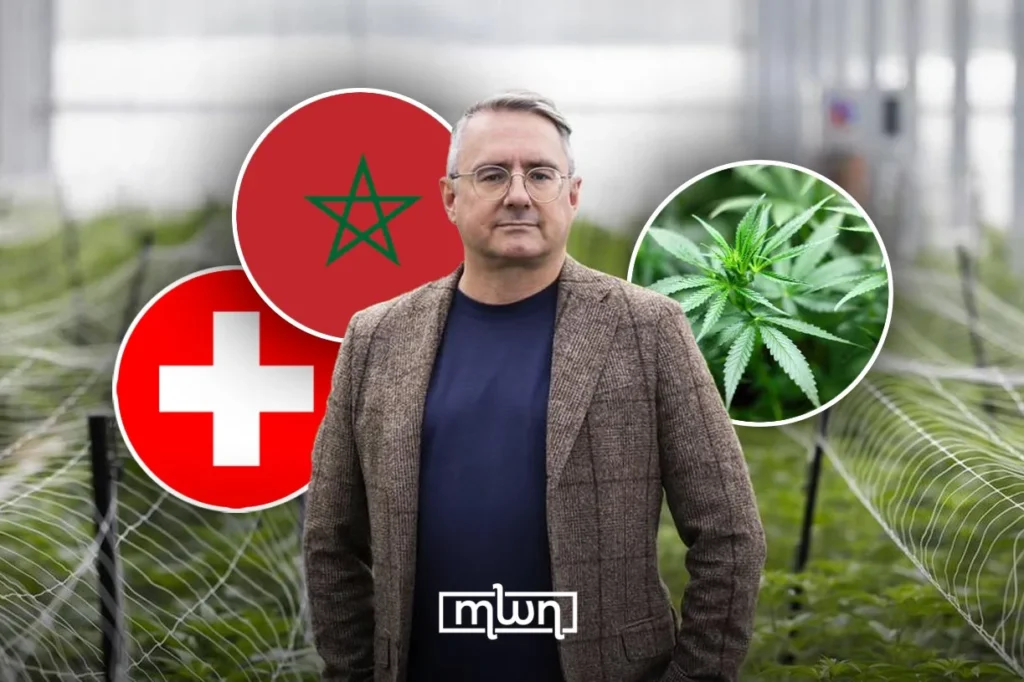
Paul-Lukas Good has dedicated years to uncovering empirical responses to this challenge. As a Zurich attorney now leading Swiss Cannabis Research, he manages Switzerland’s largest cannabis study, involving a pilot program with up to 7,500 participants in Zurich, alongside another ongoing trial with around 5,000 participants in St. Gallen, both in collaboration with the University of Zurich and ETH. This spring, Good visited Morocco, and in an exclusive interview with Morocco World News (MWN), he shared his insights and the potential exchanges between these two countries.
Good’s assessment of Morocco’s path was both respectful and insightful. “It appears to be navigating its progress thoughtfully and systematically,” he noted. “Legalizing cultivation and industry as a first step was a strategic choice; it integrated farmers into a regulated economy and established a foundation for the entire sector.”
This foundation is rooted in Law 13-21, the 2021 legislation that shifted cannabis from the realm of criminality into a regulated framework for medical, pharmaceutical, cosmetic, and industrial applications. It established a dedicated regulatory body, ANRAC, and organized the Rif’s farmers into licensed cooperatives, converting a historic crop into traceable, taxable income. Three years later, the agency reports that 5,765 operational authorizations have been granted—5,492 for cultivation, benefiting 5,318 farmers—after releasing 4,147 new permits in 2025 alone.
For Good, however, the true moral impetus behind the reform lies in the 2024 royal pardon. King Mohammed VI granted clemency to 4,831 cultivators who had been convicted or pursued for a crop that had supported their families for generations. “The royal pardon illustrated true leadership to me,” he remarked. “It regarded the farmers not as criminals but as citizens whose livelihoods had simply been affected by outdated laws.”
His enthusiasm for the Moroccan situation eclipses the Swiss narrative. “In Switzerland, the conversation has only recently emerged,” he pointed out. “In Morocco, cannabis is intertwined with the history and livelihoods of communities in the Rif, going back generations. This makes it complex, yet it also reflects a more authentic truth: the plant is embedded in the social fabric, as is its consumption.”
The Challenge Facing Both Countries
Good sharpens his argument into a clear thesis: while legalizing cultivation addresses part of the issue, it does not complete the equation. “Once you accept that prohibition has failed to eliminate cannabis, what constitutes responsible regulation—not only regarding cultivation but also its recreational use?”
His response is lucid and cautiously defined. “The logical progression in this dialogue is towards a regulated market for recreational use—not a free market, but a regulated one,” he stated. “If you leave consumption illegal and unregulated, you hand that sector over to organized crime, even if you’ve legalized farming.”
This represents a significant gap left by Morocco’s current reform. The legal framework, by various credible estimates, captures only a small fraction of what the mountains produce. In a statement to MWN, Chakib El Khayari, coordinator of the National Collective for Cannabis Legalization, revealed concerning statistics: against a backdrop of over 60,000 families reliant on the plant, the 5,318 licensed growers account for under 10% of potential cultivators. “More than 90% remain associated with the illicit market, not because all are traffickers,” El Khayari clarified, “but because the illegal economy remains the sole viable option for many.”
Good emphasizes the critical need to close this gap through effective methods rather than political maneuvering. He argues that the Swiss trials aim to replace instinct with evidence. “The significance of these trials lies in their capacity to inform legislation through research findings rather than mere intuition,” he explained. Switzerland has established a methodical approach—a monitored, step-by-step process that produces reliable evidence.
Could Morocco leverage ANRAC and a few years of regulatory experience to implement something comparable? Good refrains from prescribing specific measures, citing his lack of familiarity with Moroccan law. However, he acknowledges that the necessary structures are in place. “An agency that already licenses farmers and tracks legal supply is, in principle, equipped to oversee a time-limited, scientifically monitored trial,” he reasoned. “The guiding principle—test, measure, then legislate—isn’t exclusive to Switzerland; it’s simply sound policy.”
Dismantling the Gateway Myth
Addressing the prevalent concern in legalization debates—the notion that cannabis serves as a gateway to harder drugs—Good offers a blunt rebuttal. “For me, that belongs in the realm of myths,” he stated. “When a gateway exists, it’s typically the dealer rather than the cannabis.”
He explains that dealers often offer a range of products and have an incentive to steer clients towards higher-margin options. “A regulated market severs that connection because the point of sale isn’t criminal.”
Good extends this rationale to public health, rejecting claims that studies like his downplay risks. “We take health risks seriously, and it doesn’t serve the supportive case to ignore them,” he acknowledged. His trials provide easy access to addiction specialists, controlled-THC products, and tobacco-free options. The contrast he draws is almost forensic: “The black market operates entirely devoid of health protocols—no age verification, quality control, dosage information, or access to treatment. A well-regulated market diminishes illegal trade and, critically, replaces a system lacking health safeguards with one that incorporates them.”
This framework for harm reduction closely aligns with the perspective El Khayari advocates in Morocco. “The adopted approach must focus on risk reduction rather than promoting consumption,” he asserted. “It should ensure product quality, prohibit sales to minors, inform users, direct the vulnerable towards care, and erode the financial power of criminal networks.”
His political directive is succinct: “This isn’t about advocating for chaotic or commercial liberalization of cannabis. It’s about initiating a serious national discussion on a strictly regulated recreational legalization, rooted in public health, risk reduction, the protection of minors, the diminishing of the illicit market, and the economic integration of farmers.”
Current Political Landscape in Morocco
That conversation is increasingly relevant within Morocco’s political circles, transcending typical partisan boundaries. The Authenticity and Modernity Party (PAM) has shown considerable interest. Ahmed Touizi, its House of Representatives chair, expressed in November 2024 that his party was “very open” to exploring recreational regulation and ready to propose or support a bill—conditioned on studies indicating no health risks and a tangible reduction in trafficking. He argued that regulated, licensed sales are preferable to driving consumers towards unregulated products in the black market.
Mustapha Benali, secretary-general of the Democratic Forces Front, has taken an even bolder stance. In April 2026, he emphasized that his party regards recreational regulation as crucial, arguing that a purely repressive approach “is ineffective on its own,” while referencing around 50 countries that have shifted their policies and the World Health Organization’s (WHO) reclassification of cannabis.
In contrast, the Justice and Development Party (PJD) has firmly rejected this path. In November 2024, Mustapha Ibrahimi denied the possibility of recreational legalization “absolutely and unequivocally,” invoking the gateway theory Good critiques, and alluding to the mixed experiences in the Netherlands. His concluding questions—whether one had ever met a kif consumer “in good health”—highlight the moralistic tone with which his faction approaches the issue.
Unique Stakes for the Rif Region
Good reserved his most compelling observation for the economic implications that differentiate Morocco’s situation from Switzerland’s. “In Switzerland, regulation predominantly concerns health and crime,” he noted. “In the Rif, cannabis has sustained entire communities for generations, and the legal cultivation framework currently encompasses only a fraction of what is produced—most crops, and the majority of income, continue to be illicitly traded, sold at prices the legal market cannot match.” The unresolved issue, he posited, is whether this shift could finally bring the informal economy into the light, serving as a critical income source for both farmers and the state.
He anticipates that Switzerland will legislate for recreational use by “2028, before our study even concludes”—a candid acknowledgment that politics may advance more rapidly than research, even in a landscape designed to examine cannabis policy.
In closing, he extended a courteous yet pointed observation for Moroccan readers: “Morocco’s relationship with this plant is far deeper and more complex than ours,” he reflected. “However, when it comes to the essential questions, we grapple with the same issues. There’s immense potential for mutual learning if we remain open to sharing what the evidence reveals.”