



Canada’s World Cup journey concluded on Saturday as they fell 3-0 to Morocco, ending their run in the round of 16.
The co-hosts had never previously earned a point in World Cup history until this edition. They managed to draw against Bosnia and Herzegovina in their opening match, secured a victory over Qatar, advanced from Group B, and triumphed over South Africa in the round of 32 to reach this stage.
However, Morocco, which reached the semi-finals in 2022, proved to be too formidable for Jesse Marsch’s side. Morocco will now face off in the quarter-finals on July 9.

In the first half, Canada displayed a superior performance despite failing to convert their chances. Morocco suffered an injury setback in the 22nd minute when Ismael Saibari had to exit the match.
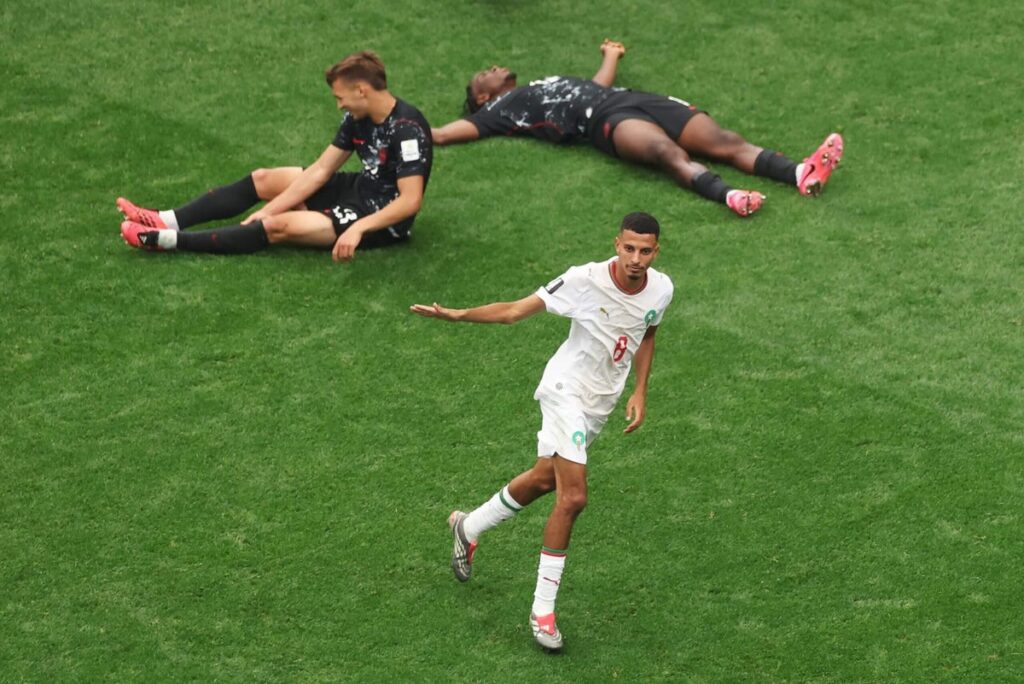
After a lackluster first half, Morocco regrouped after halftime. In the 50th minute, a well-executed free kick resulted in Azzedine Ounahi striking from the edge of the box. Ounahi increased the lead in the 82nd minute, and Soufiane Rahimi sealed the game with a third goal during stoppage time.
In this piece, The Athletic’s Joshua Kloke, Nick Miller, Carl Anka, and Liam Tharme discuss the key highlights.
Canada’s journey concludes: How will the nation remember it?
There are many positive descriptors for Canada’s World Cup campaign.
The leap from the group stage, including a thrilling display against Qatar, rallied an entire nation that is still warming up to the sport to believe in this team’s potential. Their first knockout round victory against South Africa showcased their emergence in international soccer.
However, the reality is that Morocco is at a different skill level, which the Canadian public must acknowledge. Canada’s energetic and aggressive style kept Morocco on the back foot in the first half, a commendable effort given the disparity in experience and talent. Their unwavering playstyle should inspire belief for future World Cups.
Ultimately, Canada lacked the strategic game management that has been missing for some time, something that may improve with experience. Given Canada’s placement at the 2022 World Cup — 31st out of 32 — their exit this time should be viewed as a success.
Joshua Kloke
Morocco reaches the quarter-finals: Can they make history as the first African nation to win the World Cup?
In the last World Cup, Morocco defeated Canada 2-1, concluding their group stage run en route to an impressive semi-final appearance. Their attack, led by stars like Hakim Ziyech and Youssef En-Nesyri, was formidable.
Fast-forward four years, and the Atlas Lions boast a stronger, more talented squad. This 3-0 victory over Canada comes on the heels of a successful (pending legal rulings) AFCON campaign and further growth of Morocco’s youth teams. No team in Africa rivals them, and few are better positioned for a successful World Cup in 2030, which Morocco will co-host with five other nations.
Pele once foresaw that an African team would win the World Cup before 2000, and in 2026, Morocco is advancing confidently into the quarter-finals.

Rahimi celebrates his goal (Ronaldo Schmeidt / AFP via Getty Images)
However, they may face France, a seemingly invincible team. Morocco possesses tactical strengths that could trouble Didier Deschamps’ squad, particularly with Achraf Hakimi’s dynamic runs and Ayyoub Bouaddi’s stability in midfield. Nonetheless, few would expect them to overcome Kylian Mbappe and his teammates.
The Athletic’s Jay Harris has penned an insightful piece on the proximity of African nations to winning a World Cup, which you can read here.
Morocco now joins Egypt as the remaining CAF representatives in the round of 16. The strength of African football owes much to Morocco’s successful efforts to lobby FIFA for changes to eligibility rules.
While Morocco may not be the first African nation to win the World Cup in 2026, the future remains uncertain.
Carl Anka
What happened to Alphonso Davies?
Despite Canada’s impressive World Cup run, questions remain, particularly regarding their captain and star player, Alphonso Davies.
Davies entered the tournament as a result of a hamstring injury, making only one substitute appearance across five games. Revered as the face of Canadian soccer, he did not participate in Canada’s final match.
Why was he absent? Was he fit enough to compete? If not, was it wise to allocate a squad spot to him given the alternatives? With an independent trainer essentially managing Davies’ training during the tournament, it raises questions about who had the final say regarding his participation.
Canada could have benefited from Davies’s speed after going down 1-0 to Morocco, but he remained on the bench, leaving lingering doubts about his absence.

Davies did not feature against Morocco (Kevin C. Cox/Getty Images)
Joshua Kloke
Was this the most physical match in the World Cup?
Canada’s play style under Jesse Marsch is characterized by intensity and physicality. As assistant coach Ewan Sharp stated, “It should feel like hell to play against us.”
They implemented their strategy effectively in the first half, using a zonal 4-4-2 formation and timing their aggressive plays, ensuring the Moroccan players stayed confined towards the touchline. They were able to regain possession several times but failed to convert those recoveries into shots on goal.
What ultimately hindered them was being overly physical, despite English referee Michael Oliver’s frequent whistles. Canada committed 15 fouls in the first half, the highest for any team in a men’s World Cup match since Marcelo Bielsa’s Chile did so against Spain in 2010.
-1 – The first half of Canada vs. Morocco featured fewer shots (5) than yellow cards (6), the first time that has occurred in the first half of a FIFA World Cup match on record (since 1966).
Chippy. pic.twitter.com/lQ0ZNZTlK9
— OptaJack⚽️ (@OptaJack) July 4, 2026
With over 38 fouls and just 16 shots combined, the match saw eight yellow cards, four for each team, marking a 2026 World Cup record. This included one for Cyle Larin after he collided with Yassine Bounou while pursuing a backpass.
Questions remain about how effective such a physically demanding style, rooted in the Red Bull philosophy, can take Canada. The answer? The round of 16.
Liam Tharme
How did Morocco adapt to Saibari’s injury?
Ismael Saibari’s three-goal contribution in the group stages marked him as one of Africa’s most impactful attackers at the World Cup. With a stellar 2025-26 season at PSV Eindhoven, he earned the player of the season award before sealing a lucrative €50 million transfer to Bayern Munich.
Though best suited for the No. 10 role, Saibari has adapted to play center-forward under manager Mohamed Ouahbi. Although he had not previously played as a false nine, he has thrived in the position, forging effective links with Brahim Diaz and Hakimi on the right flank and demonstrating prowess in the box.
His exit in the 22nd minute due to injury was unfortunate, as he had emerged as Morocco’s standout player. Soufiane Rahimi stepped in, and while he may not match Saibari’s caliber, he scored the third goal to secure the victory.

Saibari suffers his injury during the first half (Kevin C. Cox/Getty Images)
Canada managed to contain Morocco during much of the first half with a smart 4-4-2 formation that shifted from zonal to man-to-man marking when necessary. Without Saibari’s creative ability, Morocco struggled to break through. However, they eventually found success through set pieces, securing an important goal via Ounahi’s well-executed finish.
Carl Anka
Did Canada regret failing to capitalize during a dominant first half?
Canada’s first-half display was strikingly dominant — even somewhat alarming — as they effectively pressured Morocco and composed their attacks.
In doing so, they executed what the Netherlands failed to do in the previous round by maintaining relentless offensive pressure. While the Netherlands struggled due to conditions, Canada thrived in the conducive air-conditioned environment.
This was likely Canada’s best half of the tournament; however, the downside was their inability to convert that dominance into goals or clear-cut chances. Yassine Bounou managed to thwart a few dangerous crosses and made a critical save against a Tani Oluwaseyi attempt.
Despite their territorial advantage, they fell short of extending their lead. It became evident Morocco would not remain subdued in the second half, and they took the lead through a goal that Canada might feel shouldn’t have been so easily achieved.
The overarching sentiment will be frustration not just with conceding a goal but also with the missed opportunities in the first 45 minutes.
Nick Miller
- Canada’s journey concludes: How will the nation remember it?
- Morocco reaches the quarter-finals: Can they make history as the first African nation to win the World Cup?
- What happened to Alphonso Davies?
- Was this the most physical match in the World Cup?
- How did Morocco adapt to Saibari’s injury?
- Did Canada regret failing to capitalize during a dominant first half?