

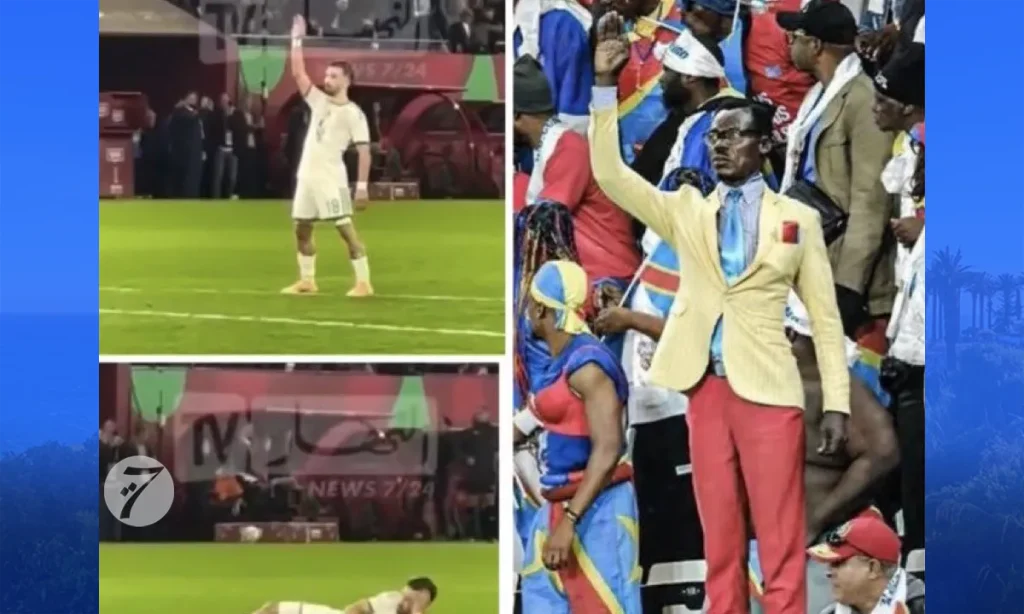

The Algerian national team defeated the Democratic Republic of the Congo by a single goal, which qualified the “Desert Warriors” for the quarter-finals. However, the most prominent event outside the field was related to a famous Congolese fan named Michel Koka Mbouladinga, known by the nickname “Lumumba Statue”.
This fan stands motionless throughout the match, raising his right hand, imitating the statue of Patrice Lumumba, the Congolese leader who fought against Belgian colonialism and became a symbol of African independence.
The stance is considered a tribute to Lumumba, who was assassinated in 1961, and this phenomenon has become iconic in the tournament, drawing everyone’s attention with its political and historical message.
After the final whistle, Algerian player Mohamed Amin Amoura (a striker for the German club Wolfsburg) approached the stands, mimicked the fan’s pose for a moment, then fell to the ground laughing, which many considered mocking or derisive.
The incident sparked widespread debate on social media, where some viewed it as an offense to a historic African symbol, especially since Lumumba supported liberation causes on the continent, including Algeria.
Amoura’s Apology The next day (January 7, 2026), Mohamed Amin Amoura posted an official apology on his Instagram account, clarifying that he was unaware of the historical significance of the stance and that his behavior was an impulsive joke in a sporting spirit without malice.
Main Text of the Apology:
“The match against Congo was very intense, filled with competitiveness, tension, and emotions on the field. I want to clarify that I did not know what that person in the stands represented. I just wanted to joke in a childlike and sporting spirit, without any bad intentions. If my actions were misunderstood, I sincerely apologize, as it was never my intention. I respect Congo and wish them success.”
Patrice Emery Lumumba (July 2, 1925 – January 17, 1961) is one of the most prominent African leaders of the twentieth century and is considered a symbol of the struggle against colonialism and the fight for independence and African unity. He served as the first Prime Minister of the Democratic Republic of the Congo after its independence from Belgium in 1960, but he remained in power for only a few months before being assassinated under mysterious circumstances involving Western colonial powers.
Despite the short duration of his rule, Lumumba became a symbol of African liberation, inspiring leaders like Nelson Mandela and Kwame Nkrumah. In 2002, Belgium officially apologized for its role in his assassination, and in 2022, it returned a tooth of his to the Congo as a symbol of justice.
Lumumba remains a witness to how colonial powers intervened to thwart emerging democracies in Africa and a call for unity and true sovereignty. His legacy lives in the hearts of millions of Africans as an unforgettable hero.