

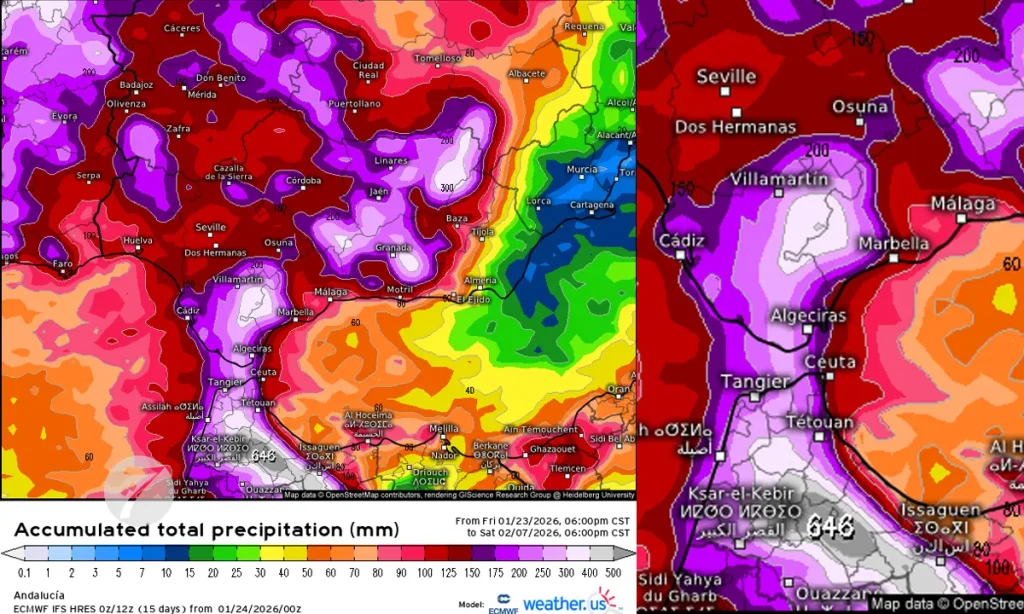

The European model (ECMWF) has revealed unprecedented forecasts for the period between January 23, 2026, and February 7, 2026, where total rainfall accumulation may exceed 600 mm in just two weeks.
These forecasts, which are being monitored very closely, showed a relative decrease in the amounts of rain expected in northern Spain, contrasted with a noticeable and concerning increase in central and southern regions of the Iberian Peninsula, as well as in northern Portugal and Galicia, in addition to northern Morocco.
According to the latest maps published by the famous European model, it is expected that rainfall amounts will accumulate to 646 mm in a large number of cities in the Tanger-Tetouan-Al Hoceima region and the Fes region, along with the neighboring areas.
It is worth mentioning that these expected amounts of rainfall could cause floods and inundations if the forecasts prove accurate.
Morocco has been affected since the end of December 2025 by a series of strong Atlantic storms, most notably Francis (which struck the country in early January with heavy rainfall and strong winds), followed by Ingrid, which continues to have an impact and has caused heavy thunderous rain and snowfall in the highlands.
According to the latest warning bulletins issued by the General Directorate of Meteorology (affiliated with the Ministry of Equipment and Water), the most vulnerable areas currently and in the coming days include:
- The Rif (Chefchaouen, Al Hoceima, Nador, and other mountainous areas).
- The Tanger – Tetouan – Larache and Loukos areas.
- Parts of the Saïss and Mediterranean coastline.
Local forecasts range between 70 and 100 mm in short periods (sometimes within 24 hours), with the possibility of exceeding these amounts in mountainous areas prone to elevations, placing the Rif Mountains at the forefront of regions susceptible to significant accumulations that may approach or exceed 600 mm over a span of two weeks.
Expected Risks in Morocco
Although these heavy rains are considered “blessing rains” after years of relative drought in some areas, the intensity and speed of the precipitation significantly raise the level of risk, and the main risks include:
- Flash floods and runoff in valleys and rivers, especially in the Rif and northwestern regions.
- Landslides and rockfalls in mountainous areas and rugged roads.
- Disruption of traffic on national and regional roads.
- Rising sea levels and wave agitation along the Mediterranean and northern Atlantic coasts.