

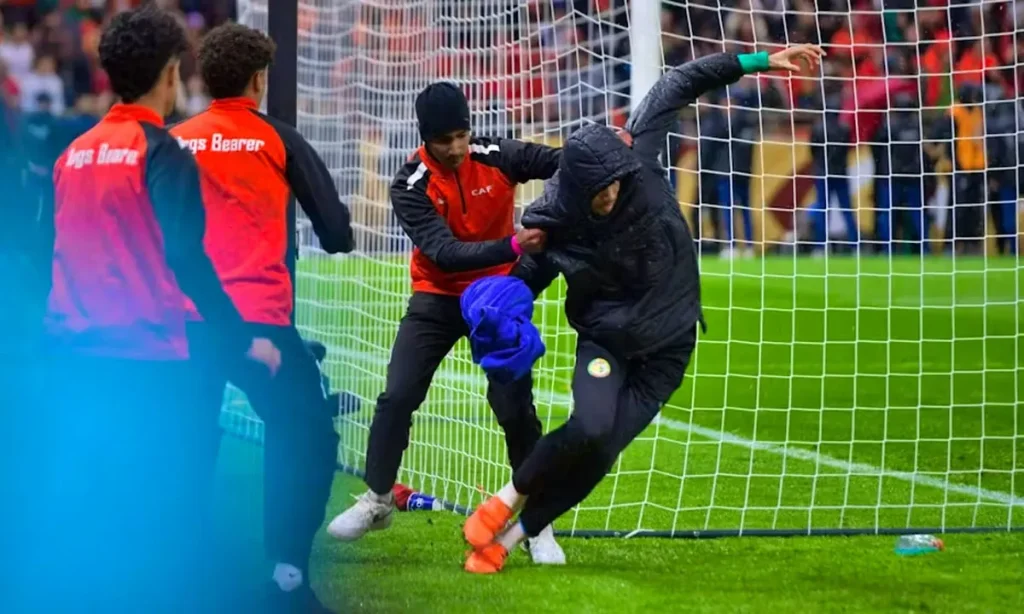

The scene of the “Senegalese goalkeeper’s towel” is no longer hidden from anyone. The footage has spread widely and turned into a topic of discussion and debate, with opinions divided between justification and accusation. However, reading the event away from emotion shows that what happened was not just a passing detail, but a scene that reflects a clear dysfunction in managing a sensitive moment during the Africa Cup of Nations final, which was supposed to be presented as a model of discipline and organization.
What took place during the match between Morocco and Senegal cannot be justified either from a sporting or organizational standpoint. The ball collectors are not part of the competition and do not possess any authority that permits them to intervene with the players’ or goalkeepers’ equipment, whether it is the ball, a water bottle, or even a towel.
Trying to pull the towel, hide it, or engage in physical contact with a substitute player because of it is considered behavior contrary to the simplest rules of neutrality. It becomes more serious when it occurs in the final of a continental championship followed by millions of viewers.
What is even more surprising is that the situation was not resolved at its inception. The tension continued, developed into physical contact, and attracted players and substitutes, without immediate and decisive intervention from the fourth official or the refereeing crew. In such major matches, small details are swiftly dealt with without hesitation, because allowing them to escalate means charging the atmosphere and derailing the match from its natural course, which actually happened.
This scene cannot be separated from a deeper aspect regarding organization. The absence of a clear protocol for dealing with the goalkeepers’ equipment behind the goal, leaving the ball collectors without strict instructions, and failing to regulate the distance between the bench and the playing area, are all indicators of organizational shortcomings that allowed a simple detail to escalate into a visible crisis on the field. Continental finals are not managed by reactions, but by preventing the causes of chaos before they occur.
From a legal standpoint, there is no text prohibiting the goalkeeper from keeping a towel to dry their hands, whether due to rain or humidity. Even in the case of suspicion that it contains tactical notes or special instructions, the matter should be addressed through official inspection or the referee’s warning, not through physical confrontations or interventions from unauthorized parties.
In conclusion, what happened harmed the image of the final more than it served any party. It contributed to escalating an already tense atmosphere, opened the door to interpretation and doubts, and cast shadows over a match that was supposed to be decided only on the green rectangle.
All of this could have been avoided by respecting the rules of neutrality, good organization, and swift intervention at the right moment. The Africa Cup final should be decided by playing the ball and clear refereeing decisions, not by a side detail that turns into a point of contention in one of the continent’s most important matches.
Follow Tangier 7 on GOOGLE NEWS and Facebook. Also on Instagram. In addition to X and Nabd App.