

The Kingdom of Morocco has reached a new milestone in its industrial strategy. The African Development Bank (ADB) has approved a loan of $110 million to support the construction of Africa’s first gigafactory dedicated to electric vehicle batteries. Led by Gotion Power Morocco, the project aims to position the Kingdom as a key regional hub for electric mobility and green technologies.
The African Development Bank announced on Friday that it has approved a loan of $110 million in favor of Gotion Power Morocco to finance the construction of Africa’s first gigafactory dedicated to manufacturing batteries for electric vehicles, according to the American news agency Associated Press (AP).
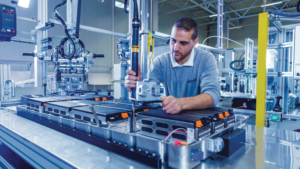
The factory will be located in the Rabat-Salé-Kénitra free zone and will produce lithium iron phosphate (LFP) batteries, a technology recognized for its safety, durability, and competitive cost.
Beyond this loan, the ADB plans to mobilize up to $162.6 million more from development partners under the New African Financial Architecture for Development, where it acts as the lead arranger, adds AP, whose regional office is in Nairobi.
A continental industrial project
Led by the Chinese group Gotion High-Tech, the complex will be the first integrated battery manufacturing plant in Africa, the Middle East, and North Africa.
In its first phase, the site is expected to produce 10 gigawatt-hours (GWh) of battery cells and packs annually for electric vehicles, before gradually increasing its capacity to 100 GWh.
This scaling-up comes as the adoption of electric vehicles accelerates across the African continent, driven by soaring fuel prices and the desire of states to develop cleaner, cost-effective transport solutions.
A lever for energy transition
According to Kevin Kariuki, ADB Vice President in charge of Energy, Climate, and Green Growth, energy storage is “the missing link in Africa’s energy transition.”
He believes that a facility of this scale, primarily powered by renewable energies, will strengthen the foundations necessary for large-scale deployment of solar and wind energy on the continent.
The official also estimates that the project will help provide reliable, low-carbon electricity while creating green jobs and reinforcing the supply chains essential for Africa’s energy transition.
Morocco as a future regional hub
The ADB country director for Morocco, Achraf Tarsim, believes that this project will enhance the industrial competitiveness of the Kingdom.
“It will help foster an African industrial ecosystem for batteries and electric vehicles while encouraging local valorization of critical minerals essential for the energy transition,” he stated.
The first phase of the project is expected to generate over 600 direct jobs and achieve 70% local industrial integration, promoting skill development and the emergence of a national supply chain.
Confirmed industrial ambition
This investment is part of Morocco’s strategy to become a regional hub for electric mobility and green technology industry.
The country already hosts over 250 companies specializing in automotive construction and component manufacturing, including Renault and Stellantis, alongside numerous Chinese, Japanese, American, and South Korean manufacturers.
With this gigafactory, Morocco hopes to strengthen its position at the heart of the new global electric battery value chain and accelerate its positioning as a reference industrial platform for Africa, Europe, and the Middle East, AP emphasizes.