


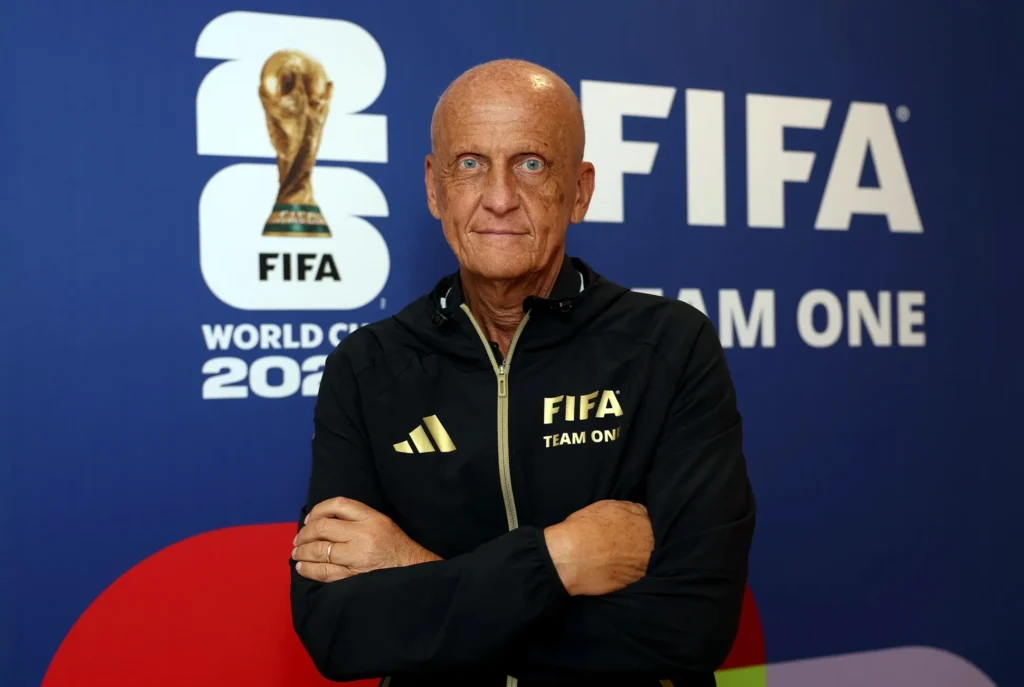

The chairman of the FIFA referees committee, Pierluigi Collina, stated that there is no room for unfounded accusations in football in response to the allegations made against the federation by the Egyptian team after their elimination at the hands of Argentina.
Collina said in official statements: “In general, we are happy. But with the large number of matches in a relatively short period of time, it is normal for some things not to go as expected. And when that happens, the referees are ready to work harder to ensure they are fully prepared for the next match.”
Collina expressed his strong rejection of the unfounded accusations sometimes directed at referees, warning that they could lead to threats against referees and their families. He said: “Constructive discussion about decisions is an integral part of football, but unfounded accusations have no place in our sport. No one can question the integrity of World Cup referees.”
Collina affirmed the complete independence of the officiating team, saying: “No one can claim that FIFA officiating can be influenced, not even President Gianni Infantino. He has always shown full support for the refereeing team with complete confidence in their work with full independence. Referees make honest decisions and do their utmost just like the players and coaches.”
Clarification Regarding VAR Technology After Goals
Collina addressed another topic that stirred controversy during the tournament, which is the mechanism of how the Video Assistant Referee (VAR) operates after goals are scored. He stated that VAR examines the attacking possession phase (APP) after each goal, and if a violation is detected in the build-up to the goal, the referee is advised to review it on the field.
He clarified that there is no specific time limit or distance for intervention, adding: “We believe that a violation is a violation. Regardless of whether it seems obvious or not, if the referee does not see it on the field, VAR can intervene.”
Examples from the Argentina vs. Egypt Match
Collina cited the Argentina vs. Egypt match as clear examples:
- The first: The Egyptian player Marwan Attiah (number 19) clearly touched the Argentine defender Lisandro Martínez (number 6) with his foot, which the refereeing committee considered a foul deserving of annulment.
- The second: The contact between Mohamed Salah (number 10) and Julián Álvarez (number 10) at the end of the match, which was considered a natural contact in football, and the goal was not annulled.
Collina concluded: “Of course, there is always a subjective element in some decisions, but we are satisfied with how this principle was applied throughout the tournament.” This statement comes at a sensitive time in the World Cup, as attention turns to the remaining knockout rounds, amidst great anticipation for the level of refereeing performance in the crucial matches.