


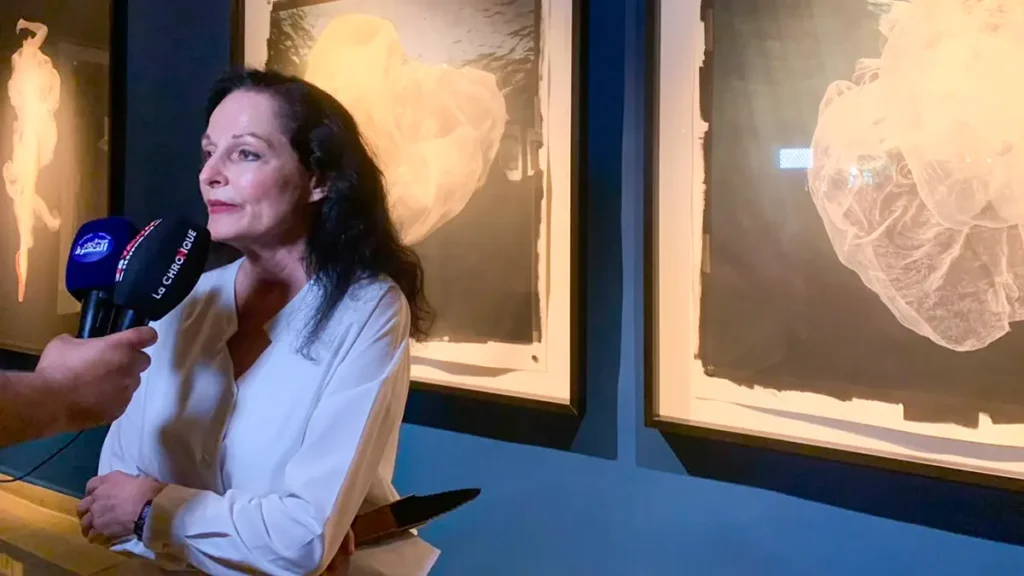

Isabel Muñoz’s exhibition, titled “The Sea That We Are,” is now showcased in a striking navy blue setting at the Cervantes Gallery in Tangier. This event is part of the cultural agenda organized by the Cervantes Institute in Tangier, which is the principal institutional partner of the Photo Tanger International Festival, ongoing from June 17 to August 31.

Juan Vicente Piqueras, the director of the Cervantes Institute in Tangier and Larache, introduced Isabel Muñoz as an artist full of passion, highlighting that she embodies multiple talents: dancer, diver, anthropologist, musician, archaeologist, activist, painter, sculptor, and alchemist.
The theme of Muñoz’s exposition, “the sea that we are and the sea from which we come,” includes unique works that showcase submerged dancers and traditional printing methods on glass and silver, reminiscent of the 19th century. This technique offers visitors a nostalgic experience through the creativity of Spain’s most renowned photographer.

Social and Environmental Commitment
Isabel Muñoz, born in Barcelona in 1951, honed her photography skills in Madrid during the late 1970s before embarking on global travels, capturing the nuances of tribes, dancers, conflicts, and social issues like violence, slavery, and migration.
With over forty years of creativity, Muñoz merges artistic insight with deep social commitment. Early in her career, she explored the human body as a medium to investigate identity, emotions, and culture, gradually extending her focus to social and environmental contexts, advocating for human rights and nature conservation.

Her unique style, defined by black and white imagery and traditional techniques like platinotype, has earned her prestigious accolades, including the National Photography Prize (2016).
Through her works of underwater dancers, Muñoz contemplates the future of young generations, asserting that “photography conveys emotions and messages; it gives a voice to the sea and nature.”
She passionately highlights the pressing issue of climate change, calling for the protection of the Mediterranean from the influence of plastic pollution, stating, “What we leave in nature, nature returns to us.”

The Sea That Unites Morocco and Spain
Isabel Muñoz’s exhibition, “The Sea That We Are,” vividly portrays a sea that transcends its role as a mere geographical barrier to become a realm of shared memory, linking Morocco and Spain through the dynamic lens of art.
Muñoz expressed her joy at choosing Tangier for her exhibition, especially as part of the inaugural Photo Tanger International Festival, chaired by the Franco-Moroccan writer, poet, and painter Tahar Ben Jelloun.
Inspired by Juan Goytisolo’s perspective in “The Sea That We Are,” Muñoz reinforced that the Mediterranean and the Strait serve as interconnected spaces of cultural exchange and coexistence, where the sea profoundly influences the collective memories of both regions; she aims to narrate and transform visual experiences into meaningful human stories.
Enthralled by the beauty of marine ecosystems, the photographs in this exhibition—captured by Muñoz in 2016 and 2017 beneath both the Mediterranean and various seas around Japan—shed light on the perils facing aquatic life.

Muñoz’s Photographic Art
All works featured are crafted through platinum printing, a demanding and costly process, which is regarded as one of the most prestigious forms of photographic artistry. Their exquisite quality and longevity render platinum prints esteemed collectibles for photography enthusiasts and investors alike.
Isabel Muñoz is celebrated as one of the foremost authorities in platinum printing. After more than a decade of dedicated research, she has innovated by incorporating color into this process, marking a significant milestone in photography.
For Muñoz, photography encompasses it all: images, video, and objects. Celebrating Photography Month acknowledges the art’s significance in the 21st century, particularly considering young audiences often disengaged from museums; photography and cinema serve as intimate entry points for them.

Her work uses photography as a reflection tool for identity, memory, cultural richness, and the human experience. She states, “Beauty and light, art, music, and cinema are what help us endure challenging times we may face,” as she conveyed to national and international media in Tangier.
Isabel Muñoz has never utilized models; she prefers working with real individuals—journalists and activists—in fact, she trained to dive to better connect with the subjects she portrays.