


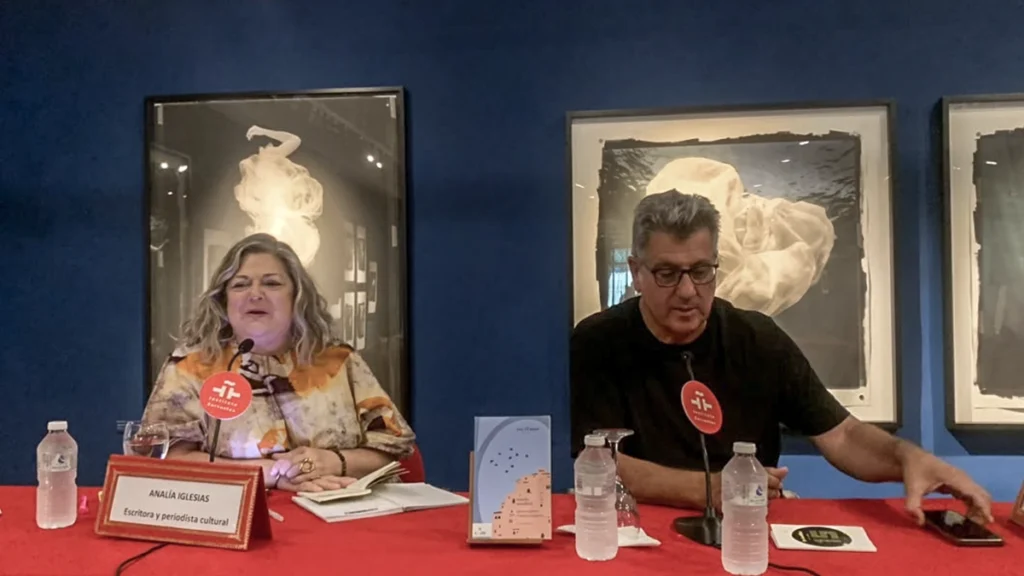

On June 30, the Cervantes Institute in Tangier hosted a literary event at its Art Gallery featuring Argentine author Analía Iglesias. Titled “Do we write or are we written? Does destiny exist?”, the event saw the presentation of her book “Mashi Mushkil: Approaches to Maghreb Destiny“, released in 2021.
In her book, Analía captures the essence of the Moroccan environment, revealing a world that may be unfamiliar to many visitors but is deeply resonant for her. Having transitioned from being a tourist exploring Marrakech and the narrow alleys of the medinas in Fez, Rabat, or Tangier to a resident immersed in the vibrant lives of Moroccans, she offers an intimate portrayal of urban life.

Analía Iglesias in Morocco
Born in Argentina, Analía Iglesias has spent the last twenty years in Spain and has worked as a university lecturer in Morocco at Hassan II University, where she helped establish the Casa-Docks film venue in Casablanca.
While in Morocco, Iglesias also organized various film series and conferences focused on climate change and curated the documentary section at the Salé International Women’s Film Festival.
Throughout her four years in Rabat, she developed the manuscripts that constitute “Machi Mushkil: Approaches to the Maghreb’s Destiny“, published in 2021 by the local publisher Alcion Editora.
Dedication to the Maghreb and Africa
Analía Iglesias, a writer and journalist, contributes to El País and other Spanish and Latin American media focusing on cultural and gender issues, human rights, science, and the environment, with an emphasis on the Maghreb and Africa.
Currently, she continues to report, from Madrid, on socio-cultural and artistic initiatives originating from the Maghreb, the Sahel, and West Africa. Additionally, she writes biographies of influential women in history for RBA, a Barcelona-based publisher of books, magazines, and collectibles.