

Over the past quarter-century, Morocco has transformed from a nascent player in the aerospace industry to a bustling hub of 150 companies generating $2 billion in annual turnover and employing 20,000 skilled workers.
This all started in 1999 when the Moroccan King Mohammed VI promulgated a royal will to diversify the national economy.
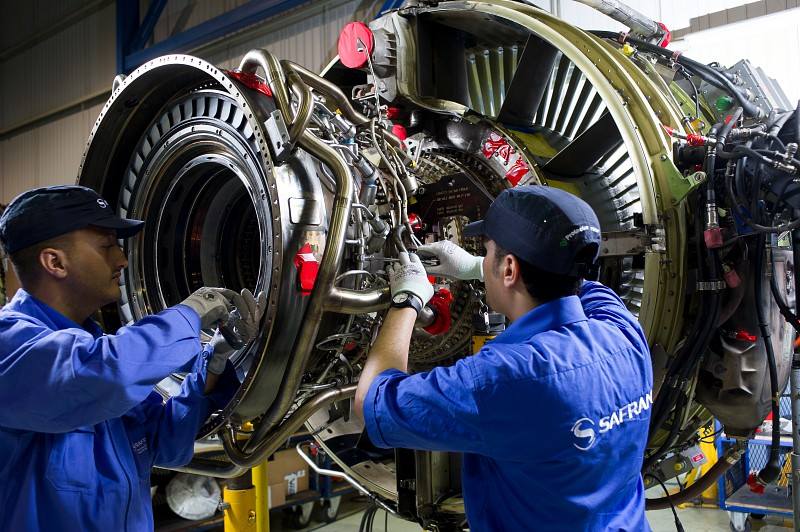
Royal Air Maroc, Morocco’s flagship carrier, subsequently collaborated with SNECMA to create SMES (SNECMA Maroc Engines Services) which was later renamed Safran Aircraft Engine Services Morocco (SAESM), with the initial goal of providing maintenance, repair and overhaul (MRO) services for the CFM56 engine.
In 2001, Matis Aerospace, a joint venture between Safran, Boeing, and Royal Air Maroc, was established, producing belt and wiring systems which marked the entry of Morocco into the supply chains of major manufacturers. Since then, Morocco has successfully been able to attract many more companies.
One of Morocco’s major advantages is its geographic proximity to the European Union (EU), with the EU also being the main trade partner for Morocco and also its biggest foreign investor with more than half of foreign direct investment (FDI) coming from the EU.
Additionally, Morocco’s young, skilled workforce, whose average age is under 30, is a major advantage combined with the government’s commitment to train specialized workers. IMA Casablanca (Institut des Métiers de l’Aéronautique) or the Institute of Aeronautical Careers is one of the main institutions that trains workers, and began operating in 2011 with over 14,000 people trained since then.
Labour is indeed cheaper in Morocco but according to industry leaders, the primary reason for the Moroccan aerospace industry’s success is a very supportive environment. Among the other advantages are lower land value and fast-track procedures which allow building permits to be obtained in just two weeks, as well as exemption from corporate taxes for five years with a 20% rebate later on, exemption from VAT and custom duties, and freedom in regard to which currency is used for commercial transactions.
It also helps that industrial hubs are well placed and sufficiently large. Next to Casablanca Mohammed V airport is Aéropole which is the primary industrial acceleration zone in the country dedicated to the aviation sector. It was expanded in 2013 with the opening of a new hub, Midparc Casablanca, which provides clear financial benefits for newly implanted companies, and a number of industrial buildings that are quickly made available. It offers more than 120 hectares of land today.
More than 20 years later, Safran now has more than 4,100 employees in Casablanca and produces more than 150,000 sets of aircraft wiring while MATIS aerospace went from 350 to 1,100 employees. The French manufacturer’s last major announcement came on 13 February 2026 when it was announced that a new landing gear plant would open its doors in Morocco. Drawing from previous experience with the CFM56, of which a rate of 70 to 100 shop visits per year was announced for 2026, Safran now provides MRO for the CFM LEAP engine but also announced in October 2025 that it would open an assembly line for the LEAP-1A engine which could produce as many as 350 engines per year.
Numerous other companies have since then followed suit, helped by the creation of the GIMAS, Morocco’s Aerospace Industries Association, in 2026. The association, which claims a 17% average annual growth rate, encompasses 142 companies including primes such as Safran; Boeing, which plans to produce parts for its 737 MAX (including via Casablanca Aéronautique, the local subsidiary of French Figeac Aero); Hexcel, which locally produces helicopter blades or engine nacelles; Airbus, primarily producing metal subassemblies, piping and composite parts as well as various components previously produced by Bombardier and Spirit Aerosystems; Embraer, which opened an MRO facility; Pratt & Whitney, Thales, Daher or Howmet. Morocco has indeed come a long way from the beginning of the 2000s when only five companies were involved in the sector.
A common strategy displayed by Morocco – mainly through both the Ministry of Industry and the Moroccan Investment and Export Development Agency (AMDIE) – to develop its industry has been to create ecosystems centred on large manufacturers. The Kingdom passed agreements in 2016 with Boeing to attract its subcontractors the same way it had done so with Renault in the automotive industry.
While no aircraft is fully assembled in Morocco, Pilatus now possesses a local semi-final assembly line dedicated to its best-seller, the PC-12, although there is yet to be a proper roll-out of a Moroccan-assembled aircraft. The recent success toward assembly of the LEAP-1A engine is a positive sign for Rabat which has long dreamed of assembling aircraft locally.
Adding to the successes of its industry, Moroccan air traffic is also growing at an impressive pace, with 2024 air traffic reaching 32.7 million passengers after a 21% increase over a year. To sustain such massive growth, Morocco’s flagship air carrier, Royal Air Maroc (RAM), plans to quadruple its fleet by 2037 while many of the country’s airports are now planning to increase in scale to provide adequate infrastructure. Airports of Morocco, the group which manages Moroccan airports, plans to double the capacity of its airports in Marrakech, Tangier, Agadir and Fez, and to triple the capacity of Casablanca’s airport with a new terminal awarded in December 2025 to Moroccan construction grouping SGTM-TGCC, linked to Morocco’s High-Speed Rail lines for a pricing of at least $1 billion and a planned capacity of 20 to 30 million passengers per year.
More connections will only increase the attractiveness of Morocco, which is also facing the emerging competition of other commercial aviation industry hubs such as Tunisia, Ghana, Ethiopia, Egypt, and a few others, as Africa’s passenger traffic is expected to double by 2044 and grow at an annual rate of approximately 4.1% over the next 20 years, according to the International Air Transport Association (IATA), due to “burgeoning middle class, increased urbanisation, rising tourism, and expanding business connectivity across the continent.”
Written by ADIT – The Bulletin and republished with permission.