
When Malagasy entrepreneur Mora Manantsoa Randriamisata came to Morocco’s International Agriculture Show last year, he did not yet have a company. He left with the foundation of one.
“SIAM really marked the beginning of our entrepreneurial journey,” said Randriamisata, who returned this week to the 18th edition of the Meknes fair representing his newly established Moroccan import business, trading Malagasy spices, natural remedies, and essential oils.
The fair, running April 20-28, draws participation from 70 countries with delegations including Cameroon, Côte d’Ivoire, Mali, Madagascar, and Uganda alongside European and Gulf partners.
More than 1,500 exhibitors, 45 foreign delegations, and an expected 1.1 million visitors confirm its standing as one of Africa’s largest agricultural showcases.
For small West and East African producers with limited resources for international promotion, the fair offers infrastructure they cannot otherwise afford. Morocco has built its position as a continental trade bridge, the leading investor in West Africa and the second largest on the African continent overall, with exports within Africa consistently rising since 2014.
Sub-Saharan Africa itself recorded 16% export value growth in the first half of 2025, making access to Moroccan networks and onward European markets more consequential than ever for small producers.
Masroum Mbaye, a Malian natural products entrepreneur on his fourth visit, said last year’s edition yielded eight new partnerships and MAD 50,000 in profit. “We’ve seen real progress over the years,” he said. “If we hadn’t, we wouldn’t have come back.”
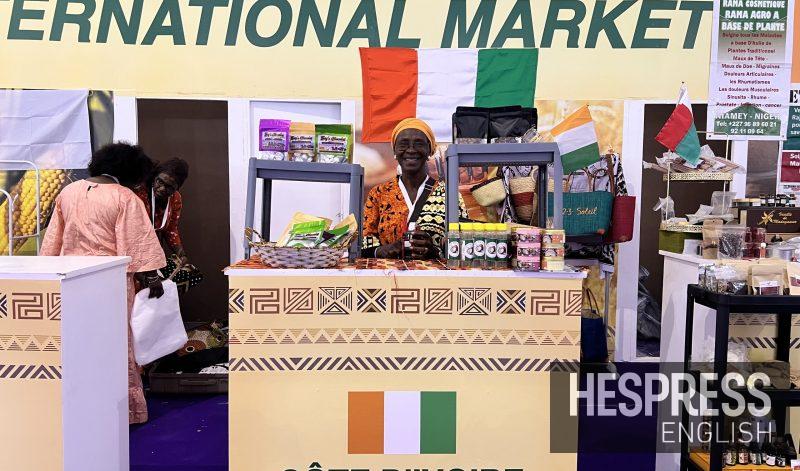
Diabaté, who has exhibited Ivorian natural oils and cocoa products at every edition since SIAM’s inception, has yet to land a Moroccan export partner but still remains hopeful about what this year’s edition can bring to her business.
Yet, the event remains an opportunity to showcase her products to visitors, as organizers expect more than 1.1 million people this year.
Gilbert Millimouno, a beekeeper from Guinea-Conakry attending SIAM for the first time, said he strongly believes in what he can achieve through the event, from opportunities to develop the beekeeping sector in his country to the experience itself.
“If we have partners and access to markets, we can increase production. Otherwise, it’s going to be hard to encourage producers to grow,” he said.
The gap between visibility and conversion is a persistent challenge for African agri-food exporters broadly. Intra-African trade remains heavily fragmented, with tariff and non-tariff barriers keeping volumes low, and exports to the rest of the world still dominated by primary commodities rather than value-added products.
But Madagasca Randriamisata’s trajectory shows it is possible. His first SIAM appearance connected him with AFEX, a commodities platform supporting African agri-food value chains through financing and digital markets, and led to client meetings that eventually pushed him to incorporate in Morocco.
“SIAM really marked the beginning of our entrepreneurial journey,” Randriamisata described.
Now in his second participation, he is looking to expand and build more partnerships in Morocco and abroad, saying the first day of this year’s edition “has already shown strong interest in his products from international traders, including people from Turkey and Poland.”