


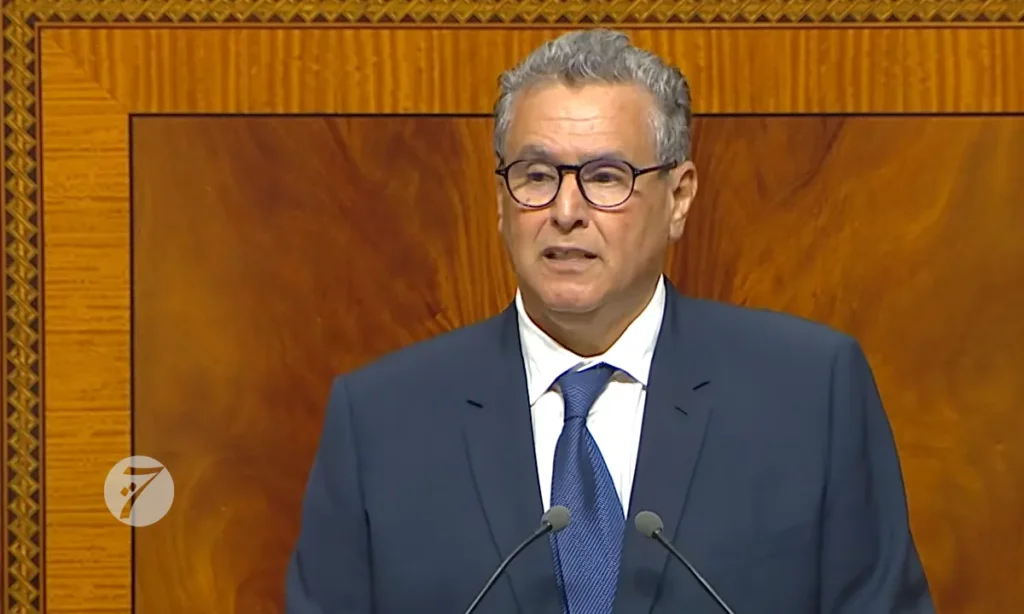

The Prime Minister, Aziz Akhannouch, stated today, Monday at the House of Representatives, that the number of students benefiting from direct social support has approached three million and 400 thousand students for the current school year (2025-2026), compared to two million and 700 thousand students during the last year.
Akhannouch clarified, in a presentation during the monthly question session regarding public policy, dedicated to the topic “The Role of the Education and Training System in Building the Rising Morocco… Government Choices and Prospects,” that one million and 900 thousand of these beneficiaries are located in rural areas.
He affirmed that the government, “from the perspective of its political and educational responsibility, has dealt with the school of justice and equal opportunities as an integral part of its vision for a comprehensive social state,” highlighting that efforts have been made to consolidate various support programs directed toward the sector, and to make the state’s resources a real mechanism to address social, economic, and spatial disparities.
In this context, he pointed out that social support has been a crucial pillar in enhancing schooling and combating school dropout rates, particularly in rural areas, emphasizing that the government has succeeded in expanding support programs to encourage families to continue ensuring their children’s schooling by including family allowances within the framework of direct social support.
In a related context, the Prime Minister noted a significant development in the number of students benefiting from boarding services, which has increased from 126 thousand beneficiaries in 2022 to about 200 thousand beneficiaries, 163 thousand of whom are in rural areas.
Akhannouch also indicated the noticeable rise in the number of beneficiaries of school feeding services, which reached 75 thousand students, including 69 thousand in rural areas, noting at the same time that significant national effort has been devoted to school transportation, which has surpassed 700 thousand beneficiaries, including 600 thousand students in rural areas.
/